Public Life • Parliament • Women & Child Development A public record · Updated September 2026

Annpurna Devi

श्रीमती अन्नपूर्णा देवी

Union Cabinet Minister for Women and Child Development

Smt. Annpurna Devi is the Union Cabinet Minister for Women and Child Development and the Member of Parliament in the Lok Sabha for Koderma, Jharkhand. She entered public life in 1998 as a member of the Bihar Legislative Assembly, served as a minister in the governments of Bihar and Jharkhand, and was Union Minister of State for Education from July 2021 before she was sworn in to the Union Cabinet on 9 June 2024.

This website presents that record from official sources: the Ministry of Women and Child Development, the Lok Sabha, the Election Commission of India and the Press Information Bureau.

Current office
Union Cabinet Minister, Women & Child Development
Constituency
Koderma, Jharkhand · Lok Sabha
Born
2 February 1970
Education
Post Graduate, Ranchi University
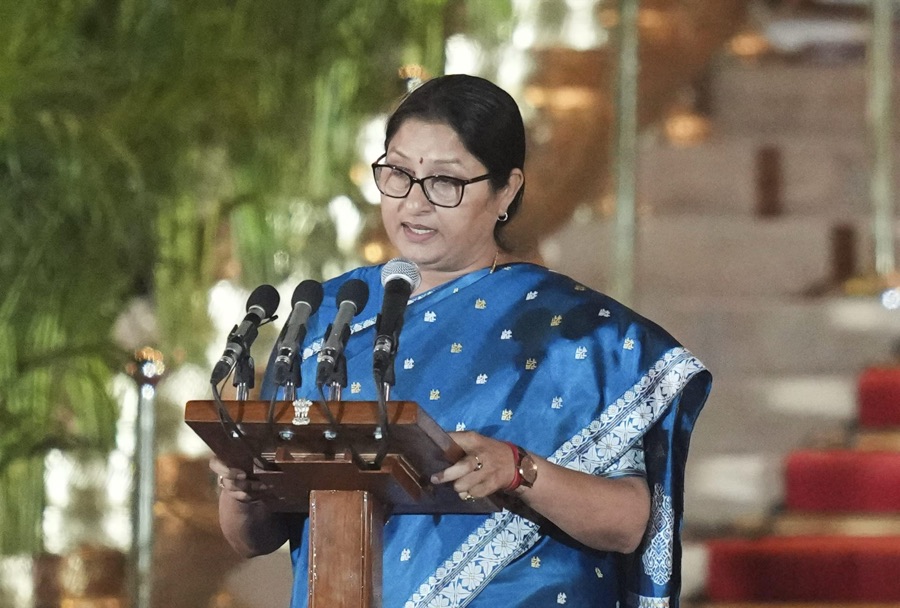
Annpurna Devi in a blue silk sari reads the oath of office at a wooden lectern with microphones, Rashtrapati Bhavan
Plate 1Taking the oath of office as a Union Cabinet Minister at Rashtrapati Bhavan, New Delhi, 9 June 2024.

A public life across Bihar, Jharkhand and India

A public life across Bihar, Jharkhand and India

From state public life to national parliamentary responsibility

Annpurna Devi’s public career runs through three legislatures and three governments. She was first elected to the Bihar Legislative Assembly in 1998 and, according to the Lok Sabha’s record of her positions, served there from 1998 to 2000 and in the Bihar and then Jharkhand assembly from 2000 to 2005. In 2000 she held office as Minister of State for Mines and Geology in the Government of Bihar.

After the creation of Jharkhand in November 2000, Koderma became part of the new state. She was a member of the Jharkhand Legislative Assembly for two terms between 2005 and 2014, chaired the Assembly’s Committee on Women and Child Welfare from 2005 to 2009, and served as a Cabinet Minister with the portfolios of Irrigation, Women and Child Welfare, and Registration — a period the Ministry of Women and Child Development records as 2012–2014.

In May 2019 she was elected to the 17th Lok Sabha from Koderma. On 7 July 2021 she became Union Minister of State in the Ministry of Education. Re-elected from Koderma in the 2024 general election, she was sworn in as a Union Cabinet Minister on 9 June 2024 and took charge of the Ministry of Women and Child Development on 11 June 2024.

Sources: Lok Sabha member record and positions held (sansad.in); Ministry of Women and Child Development, Cabinet Minister profile (wcd.gov.in); PIB release 2024158. Read the full profile.

The archive line

Twenty-eight years of public life, on one line

Milestones are drawn from the Lok Sabha’s record of positions and the Ministry of Women and Child Development’s official profile. Where the two records describe a period differently, the Public Journey chapter sets out both.

  1. 1998Bihar Legislative AssemblyFirst elected, from Koderma; member 1998–2000.
  2. 2000Minister of State, BiharMines and Geology, Government of Bihar; re-elected to the Assembly.
  3. 2005Jharkhand Legislative AssemblyMember for two terms, 2005–2014; chaired the Committee on Women & Child Welfare, 2005–09.
  4. 2012–14Cabinet Minister, JharkhandIrrigation; Women & Child Welfare; Registration.
  5. 201917th Lok SabhaElected from Koderma, May 2019.
  6. 2021Minister of State, EducationUnion Ministry of Education, from 7 July 2021.
  7. 202418th Lok SabhaRe-elected from Koderma in the general election.
  8. 2024Cabinet Minister, Women & Child DevelopmentSworn in 9 June 2024; took charge 11 June 2024.
§ 06Education

Education as a foundation

Annpurna Devi is a post-graduate of Ranchi University. From 7 July 2021 she served as Union Minister of State in the Ministry of Education, during the first years of implementing the National Education Policy 2020 — the policy that restructured school education into a 5+3+3+4 design beginning with three years of pre-school.

Official profiles published by the Ministry of Women and Child Development, the National Commission for Protection of Child Rights and the Savitribai Phule National Institute of Women and Child Development record that she headed an expert committee on the revision of the Right to Education framework in the light of NEP 2020. That record is reproduced here in the Ministry’s own words.

Press Information Bureau releases from the period document her at national workshops, teacher conclaves and conferences on foundational literacy and numeracy, and as the minister answering written questions on school education in Parliament.

The Education chapter

Office
Union Minister of State, Ministry of Education
From
7 July 2021
Sources
Lok Sabha record; MWCD profile; PIB

“She headed an expert committee on Revision of RTE (Right to Education) in view of National Education Policy 2020.”

— Ministry of Women and Child Development, Cabinet Minister profile

  1. 28 July 2022 — Presided over the National Workshop on the National Achievement Survey and released the NAS mobile application. PIB 1845985
  2. 6 September 2022 — Jointly inaugurated the Shikshak Parv 2022 conclave, New Delhi. PIB 1857180
  3. 17 June 2023 — Inaugurated the multimedia exhibition at the National Conference on Foundational Literacy and Numeracy, Pune. PIB 1933039

Note: the sources consulted do not publish the committee’s date of constitution, terms of reference or report.
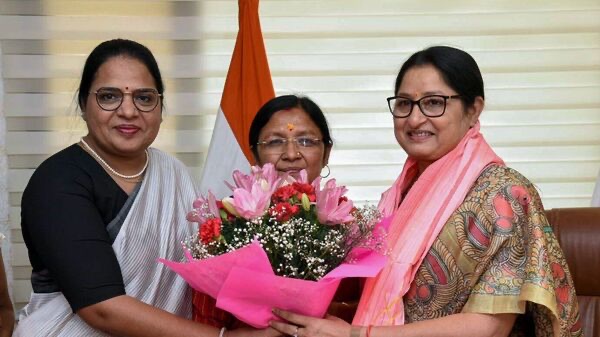
Annpurna Devi, smiling, receives a bouquet of pink lilies from two women colleagues in an office with the national flag
Plate 2Greeted with flowers at the Ministry of Women and Child Development, New Delhi, June 2024.
“Women entrepreneurs are a driving force behind India’s economic progress.” Smt. Annpurna Devi, media briefing on the Union Budget 2025–26, 11 February 2025 — as quoted by PIB (release 2101713)
§ 07Women

Women & development

The Ministry of Women and Child Development is the Government of India’s nodal ministry for policies and programmes concerning women’s welfare and empowerment. Its umbrella scheme for women, Mission Shakti, combines services for safety and security — One Stop Centres, the Women Helpline 181 and Beti Bachao Beti Padhao — with services for empowerment, including shelter homes, working women’s hostels, crèches and the Pradhan Mantri Matru Vandana Yojana maternity benefit.

Government policy increasingly frames this work as women-led development: women as decision-makers and economic actors rather than only as beneficiaries. The Nari Shakti Vandan Adhiniyam, 2023 provides for the reservation of one-third of seats for women in the Lok Sabha and state assemblies, and the Union Budget’s gender budget statement tracks allocations for women across ministries — 8.86% of the total budget in 2025–26, as reported by the Ministry.

As minister, Annpurna Devi led India’s delegation to the 69th session of the UN Commission on the Status of Women in March 2025, launched the Gender Budgeting Knowledge Hub at the first National Consultation on Gender Budgeting in June 2025, and chaired the Consultative Committee of MPs on Mission Shakti in August 2026.

  • 01Social empowerment
  • 02Economic participation
  • 03Safety & dignity
  • 04Equal opportunity
  • 05Gender budgeting
  • 06Women-led development

Women & Development chapter

§ 08Children

Child development

India’s public systems for young children meet at the Anganwadi — the village and neighbourhood centre that provides supplementary nutrition, pre-school education, growth monitoring and referral services. Around it sit the systems for children who need care and protection: Child Welfare Committees, District Child Protection Units, children’s homes, foster care and sponsorship, and the Child Helpline 1098, all brought together under Mission Vatsalya.

The Ministry’s statutory and autonomous bodies — the National Commission for Protection of Child Rights, the Central Adoption Resource Authority and the Savitribai Phule National Institute of Women and Child Development — protect child rights, regulate adoption, and train the people who run these services.

  • Early childhood

    Care, stimulation and pre-school learning from birth to six, through the Anganwadi and the national ECCE framework.

  • Nutrition

    Supplementary nutrition and growth monitoring for children under six and for pregnant and lactating women.

  • Protection

    Child Welfare Committees, children’s homes, foster care and the Child Helpline 1098 under Mission Vatsalya.

  • Learning & rights

    Child rights under the Juvenile Justice and POCSO Acts; legal adoption regulated by CARA.

Child Development chapter

§ 09Nutrition

Nutrition • Growth • Early years

Mission Saksham Anganwadi & POSHAN 2.0 is the Government’s integrated nutrition programme. It brings together supplementary nutrition, early childhood care and education, and the POSHAN Abhiyaan’s community mobilisation — the Jan Andolan — marked every year by Poshan Pakhwada in the spring and Rashtriya Poshan Maah in September.

The 8th Poshan Pakhwada, launched by the Minister on 9 April 2026, took as its theme “Maximizing Brain Development in the First Six Years of Life”, citing the evidence that more than 85% of brain development occurs by the age of six. Earlier campaigns have focused on the first 1,000 days — from conception to a child’s second birthday.

14 lakh+Anganwadi Centres delivering nutrition, health and early childhood care servicesMinister’s statement at the launch of Rashtriya Poshan Maah 2026, Varanasi — PIB 2308322, 9 Sept 2026
7.5 crore+children served by those centresPIB 2308322, 9 September 2026
1.10 crorepregnant women and lactating mothers servedPIB 2308322, 9 September 2026

Figures are those reported by the Ministry of Women and Child Development through the Press Information Bureau, on the dates shown. They are not independent estimates.

Nutrition & POSHAN chapter

The programme landscape

Three missions, read in three layers

Each mission is described first by its official objective, then by the minister’s documented participation, and finally by reported figures — kept separate so that a programme’s results are not presented as an individual’s achievement.

The Ministry’s budget for 2026–27 is ₹28,183 crore, of which ₹23,100 crore is for Saksham Anganwadi & POSHAN 2.0, ₹3,200 crore for Mission Shakti and ₹1,550 crore for Mission Vatsalya (Union Budget 2026–27, Demand No. 101).

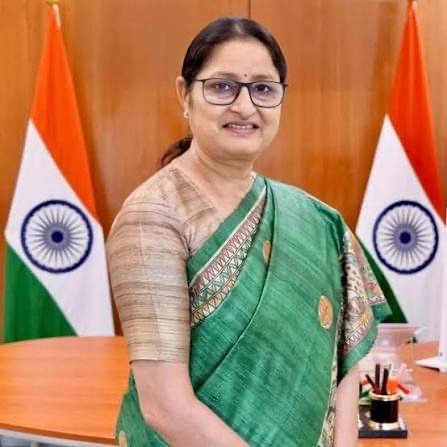
Annpurna Devi, smiling, in a green silk sari, standing in an office between two national flags
Plate 3In an office setting with the national flags. Undated.
Mission I

Mission Shakti

Safety, security and empowerment of women

Programme objective
An integrated mission for women’s safety and empowerment in two parts: Sambal (One Stop Centres, Women Helpline 181, Beti Bachao Beti Padhao, Nari Adalat) and Samarthya (Shakti Sadan, Sakhi Niwas, Palna crèches, PM Matru Vandana Yojana, hubs for empowerment of women).
Ministerial participation
Chaired the Consultative Committee of MPs on Mission Shakti, Kolkata, 21 August 2026 (PIB 2302092).
Reported figures
991 One Stop Centres functional, having assisted over 15.20 lakh women; about 4.60 crore mothers paid PMMVY benefits — as reported to that meeting.
Mission Shakti in detail
Mission II

Mission Vatsalya

Child protection and welfare

Programme objective
A child-protection system under the Juvenile Justice Act, 2015: statutory bodies, institutional care, family-based non-institutional care (sponsorship, foster care, adoption, after-care) and the Child Helpline.
Ministerial participation
Chaired the Consultative Committee meeting on Mission Vatsalya, 18 December 2025 (PIB 2206220); launched the Bal Vivah Mukt Bharat campaign, 27 November 2024 (PIB 2078032).
Reported figures
Bal Vivah Mukt Bharat awareness programmes reached over 6 crore citizens, with more than 28 lakh pledges registered — Rajya Sabha reply, 4 February 2026.
Mission Vatsalya in detail
Mission III

Saksham Anganwadi & POSHAN 2.0

Nutrition and early childhood care

Programme objective
To address malnutrition among children, adolescent girls and pregnant and lactating women through supplementary nutrition, early childhood care and education, and strengthened Anganwadi infrastructure.
Ministerial participation
Launched the 7th Rashtriya Poshan Maah, Gandhinagar, 31 August 2024 (PIB 2050437); launched the 8th Poshan Pakhwada, New Delhi, 9 April 2026 (PIB 2250637).
Reported figures
Over 11,000 Saksham Anganwadi Centres inaugurated on 30 September 2024 at the Poshan Maah closing ceremony in Ranchi (PIB 2060268).
POSHAN 2.0 in detail